Priyanka Gandhi Leads Parliament Protest Against G Ram G Bill, Calls Move to Replace MGNREGA a Threat to Rural Jobs
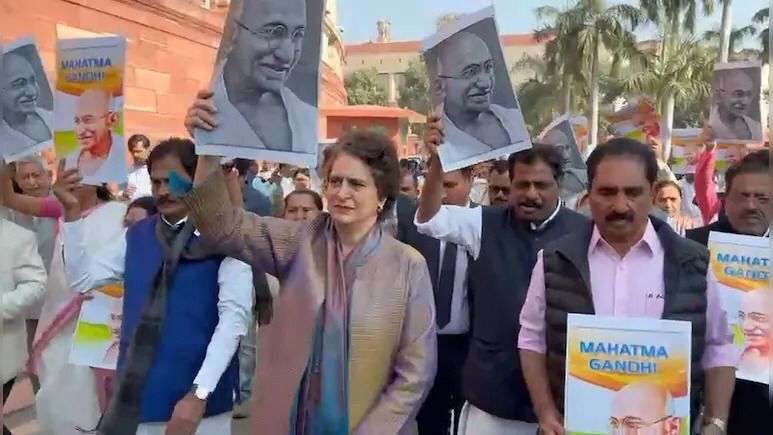
New Delhi | December 16, 2025 Senior Congress leader and Wayanad MP Priyanka Gandhi Vadra on Monday led a strong protest in Parliament against the Centre’s move to replace the Mahatma Gandhi National Rural Employment Guarantee Act (MGNREGA) with a new law, saying the proposed Bill weakens the right to employment for rural citizens and must be withdrawn. The protest took place on the Parliament premises, where Congress leaders held up photographs of Mahatma Gandhi, after whom the rural job guarantee scheme is named. The demonstration came hours after Union Agriculture Minister Shivraj Singh Chouhan sought permission in the Lok Sabha to introduce the Viksit Bharat Rozgar and Ajeevika Mission (Gramin) Bill, 2025, commonly referred to as the G Ram G Bill. The new Bill is intended to replace MGNREGA, a flagship welfare law introduced in 2005 by the then UPA government. The existing scheme guarantees 100 days of paid employment every year to rural households and has been widely credited with strengthening rural livelihoods and the village economy over the past two decades. Opposing the introduction of the Bill under Rule 72(1) of the Rules of Procedure and Conduct of Business in the Lok Sabha, Priyanka Gandhi said the government was attempting to dilute a law that has served rural India successfully for nearly 20 years. She said MGNREGA was a “revolutionary” step that received support across party lines when it was passed and continues to provide crucial livelihood support to the poorest sections of society. She argued that the proposed law changes the very nature of employment guarantee by moving away from a demand-based system. Under MGNREGA, work is provided based on demand raised at the local level, and funding is allocated accordingly. The new Bill, she said, allows the Centre to decide funding in advance, which could restrict access to work. According to her, this also weakens the role of Gram Sabhas, which currently assess the demand for work based on local needs. Priyanka Gandhi warned that the right to employment was being diluted and said such a move goes against the spirit of the Constitution. She also pointed out that the Centre’s contribution to MGNREGA funding has already been reduced to 60 per cent for most states. This, she said, places additional financial pressure on states that are already awaiting pending GST dues from the Centre. During the debate, she criticised what she described as a growing trend of renaming schemes, saying it leads to unnecessary costs and confusion. She urged the government not to rush the Bill without proper discussion and consultation. Calling for its withdrawal, she said the Centre should bring a revised proposal after taking inputs from Parliament. Responding to remarks from the treasury benches that referenced her family, Priyanka Gandhi said Mahatma Gandhi did not belong to her family but was like family to the entire nation. Her statement drew attention to the emotional and symbolic importance attached to the name of the scheme. Other opposition leaders also voiced concerns over the Bill. Congress MP Shashi Tharoor termed it “immoral” to remove Mahatma Gandhi’s name from a law that has played a key role in rural welfare. Several leaders flagged issues such as the shift to normative funding and the reduction in the Centre’s share. The government, however, defended the proposed law, stating that it aligns with its Viksit Bharat 2047 vision. Government sources said normative funding would ensure predictable and rational budgeting, unlike demand-based funding, which they described as unpredictable. They maintained that eligible workers would continue to receive employment or unemployment allowance. BJP leader Mukhtar Abbas Naqvi dismissed the opposition’s objections, saying the controversy stemmed from the inclusion of Lord Ram’s name in the Bill. According to him, the protests were driven by discomfort with the new name rather than genuine concern for rural workers. As the debate continues, the proposed replacement of MGNREGA has emerged as a major political flashpoint, with the future of rural employment support at the centre of the discussion. Priyanka Gandhi Leads Parliament Protest Against G Ram G Bill, Calls Move to Replace MGNREGA a Threat to Rural Jobs A sharp political debate unfolded in Parliament today as Congress leader and Wayanad MP Priyanka Gandhi Vadra led a protest against the Centre’s proposed G Ram G Bill, which seeks to replace the Mahatma Gandhi National Rural Employment Guarantee Act (MGNREGA). Holding photographs of Mahatma Gandhi, Congress leaders opposed the move, saying it weakens a law that has supported rural livelihoods for nearly two decades. The protest came after Union Agriculture Minister Shivraj Singh Chouhan sought permission in the Lok Sabha to introduce the Viksit Bharat Rozgar and Ajeevika Mission (Gramin) Bill, 2025. Priyanka Gandhi objected to the Bill, stating that MGNREGA has provided 100 days of guaranteed work every year to the poorest families since it was introduced in 2005. She said the scheme strengthened the rural economy and had received support from all political parties when it was passed. She raised concerns that the new Bill shifts the system from demand-based funding to pre-decided allocations by the Centre. According to her, this change could limit access to work and weaken the role of Gram Sabhas, which currently assess local employment needs. She also pointed out that the Centre’s funding share has already been reduced to 60 per cent in most states, adding pressure on state finances. Priyanka Gandhi urged the government not to rush the Bill without proper discussion and called for it to be withdrawn. Responding to remarks about her family, she said Mahatma Gandhi may not be from her family, but he belongs to the entire nation. Other opposition leaders, including Shashi Tharoor, also opposed the Bill, calling it wrong to remove Mahatma Gandhi’s name. The government, however, defended the proposal, saying it fits into its Viksit Bharat 2047 vision and allows better budgeting. With strong views on both sides, the future of India’s rural job guarantee has now become a key political issue.