
Seven Elephants Killed After Rajdhani Express Derails in Assam Following Early-Morning Collision
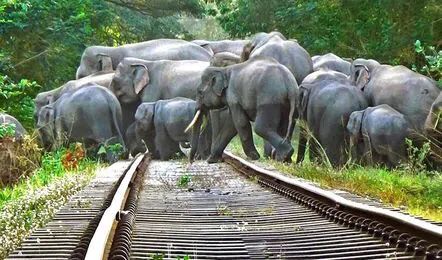
Guwahati, Dec 20: At least seven wild elephants were killed in the early hours of Saturday after the DN-Sairang–New Delhi Rajdhani Express collided with a herd in Assam’s Nagaon district, leading to the derailment of the train’s engine and five coaches. The accident occurred at around 2.17 am in the Jamunamukh–Kampur section under the Lumding railway division, officials said. The Rajdhani Express was travelling at night when the train pilot noticed a group of elephants on the track near Kampur, about 126 kilometres from Guwahati. According to railway officials, the pilot immediately applied emergency brakes on spotting the animals. Despite this effort, the elephants reportedly moved into the path of the train, resulting in a severe collision. Seven elephants died on the spot due to the impact. The collision caused the engine and five coaches of the premium long-distance train to derail, triggering concern among passengers and railway authorities. However, officials from the Northeast Frontier Railway (NFR) confirmed that no passengers or railway staff were injured in the incident. All passengers onboard the affected coaches were reported safe. Soon after the accident, accident relief trains and senior officials from the Lumding divisional headquarters were rushed to the site to manage the situation and begin restoration work. Railway teams worked through the early morning hours to assess the damage, clear the tracks, and ensure passenger safety. Passengers travelling in the derailed coaches were temporarily accommodated in vacant berths available in other coaches of the same train. Railway officials said efforts were made to minimize discomfort and confusion for travellers, many of whom were asleep when the accident occurred. In an official statement, the NFR said that after detaching the damaged coaches, the remaining part of the train was moved to Guwahati. Once the train reaches the city, additional coaches will be attached so that passengers from the affected coaches can continue their journey to New Delhi. The train is expected to resume its onward journey after necessary checks and arrangements are completed. Railway authorities also activated helpline numbers at Guwahati railway station to assist families and passengers seeking information. The helpline numbers shared were 0361-2731621, 0361-2731622, and 0361-2731623. Officials clarified that the accident did not occur in a designated elephant corridor, which are areas officially identified for frequent elephant movement. Despite this, wildlife experts have pointed out that elephants often move beyond marked corridors, especially at night, in search of food and water. Divisional Forest Officer of Nagaon, Suhas Kadam, said that forest officials had reached the spot and that further details regarding the elephants, such as their age and sex, were still being collected. Post-mortem examinations are expected to be conducted as part of standard procedure. The incident has once again raised concerns about coordination between railway authorities and forest departments. Bibhab Talukdar, chief executive officer of wildlife NGO Aaranyak, said the tragedy highlights gaps in communication and planning. He stressed that better ground-level coordination is needed to share real-time information about elephant movement with railway officials to prevent such accidents in the future. Following the derailment, trains scheduled to pass through the Jamunamukh–Kampur section were diverted through alternative routes to avoid delays and ensure safety. Restoration work on the affected track is ongoing, and railway officials said services would be normalized once the damaged infrastructure is repaired and safety checks are completed. The accident underscores the ongoing conflict between expanding transport networks and wildlife movement in the region, a challenge that continues to affect both human travel and animal safety in Assam. Seven Elephants Killed After Rajdhani Express Derails in Assam Following Early-Morning Collision At least seven wild elephants lost their lives in a tragic accident early Saturday morning when the DN-Sairang–New Delhi Rajdhani Express collided with a herd in Assam’s Nagaon district. The incident took place at around 2.17 am in the Jamunamukh–Kampur section under the Lumding railway division, nearly 126 km from Guwahati. According to officials from the Northeast Frontier Railway (NFR), the train pilot noticed the elephants on the track and immediately applied emergency brakes. Despite this, the animals reportedly moved into the path of the train, leading to a powerful collision. The impact caused the engine and five coaches of the train to derail. Seven elephants died on the spot, while thankfully no passengers or railway staff were injured. Soon after the accident, accident relief trains and senior railway officials reached the site. Passengers from the affected coaches were safely shifted to vacant berths in other coaches. After detaching the damaged coaches, the train was moved to Guwahati, where additional coaches will be added so that all passengers can continue their journey to New Delhi. Helpline numbers were activated at Guwahati railway station to assist passengers and their families. Railway authorities also diverted other trains passing through the section to alternate routes as restoration work continues. Officials said the location is not a designated elephant corridor. However, wildlife experts say elephants often move beyond marked corridors, especially at night. Forest officials have reached the site, and details about the elephants killed are being collected. The incident has once again raised serious concerns about the lack of coordination between railway and forest departments. Wildlife experts stress that real-time sharing of elephant movement information is crucial to prevent such heartbreaking accidents in the future. A tragic reminder of the growing conflict between fast-moving infrastructure and wildlife habitats.