
INSV Kaundinya: Indian Navy’s Engine-less Stitched-Plank Ship Set for Maiden Overseas Voyage
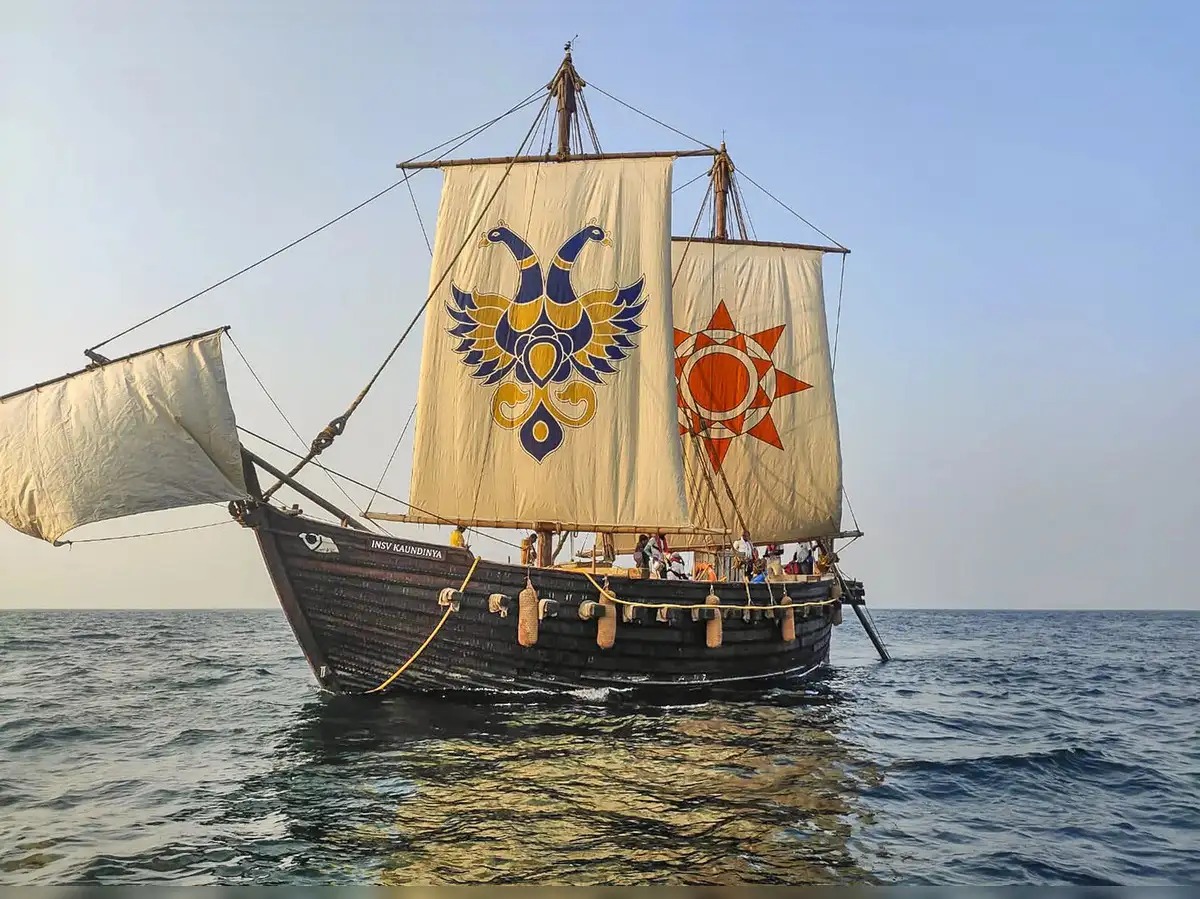
New Delhi The Indian Navy’s traditional sailing vessel, INSV Kaundinya, is set to embark on its maiden overseas voyage on Monday, sailing from Porbandar in Gujarat to Muscat in Oman. The journey aims to retrace historic maritime routes that once connected India with West Asia and the wider Indian Ocean, showcasing the country’s ancient shipbuilding heritage and navigation skills. INSV Kaundinya is entirely built using the ancient stitched-plank technique and relies solely on sails and wind for propulsion. The vessel has no engine, metal fastenings, or modern propulsion systems. It recreates the conditions under which Indian mariners once undertook long-distance oceanic voyages, highlighting the sophistication and durability of traditional shipbuilding that predates modern navigation by over a millennium. The ship’s design is inspired by depictions in the Ajanta cave paintings, references in ancient Indian texts, and accounts of foreign travelers. With no surviving blueprints, the Indian Navy reconstructed the vessel using scientific validation, hydrodynamic testing, and stability studies, with support from institutions including IIT Madras, to ensure it could safely navigate open seas. INSV Kaundinya measures approximately 19.6 meters in length, 6.5 meters in width, with a draft of 3.33 meters. It will be operated by a crew of around 15 sailors trained in traditional sailing methods. Its hull follows the Tankai method, an indigenous technique in which wooden planks are stitched together using coir ropes and sealed with natural resins, cotton, and oils. This provides flexibility to absorb wave energy, a feature essential for navigating the Arabian Sea, Bay of Bengal, and other open waters. The project began in July 2023 as a collaboration between the Ministry of Culture, the Indian Navy, and Hodi Innovations, with master artisans from Kerala hand-stitching the vessel. It was launched in February 2025 and formally inducted into the Navy in May at Karwar, Karnataka. The ship carries cultural motifs including the Gandabherunda, sun symbols on sails, a Simha Yali figure on the bow, and a Harappan-style stone anchor, celebrating India’s rich maritime heritage. INSV Kaundinya is named after the legendary first-century Indian mariner Kaundinya, who sailed to the Mekong Delta, married Queen Soma, and helped establish the Funan Kingdom in present-day Cambodia. By retracing the Porbandar-Mascat route, the vessel recreates ancient maritime highways used for trade, spices, textiles, and cultural exchange, reaffirming India’s enduring identity as a maritime civilization. INSV Kaundinya: Indian Navy’s Engine-less Stitched Ship Set for Maiden Voyage to Muscat The Indian Navy’s traditional sailing vessel, INSV Kaundinya, is set to embark on her maiden overseas voyage on Monday, sailing from Porbandar, Gujarat, to Muscat, Oman. The journey aims to retrace ancient maritime routes that historically connected India with West Asia and the broader Indian Ocean world, showcasing the country’s centuries-old maritime knowledge and shipbuilding techniques. INSV Kaundinya is a rare operational vessel built entirely using ancient stitched-plank technology, relying solely on wind and sails for propulsion. The ship has no engines, metal fastenings, or modern propulsion systems. Its construction recreates conditions under which Indian sailors once undertook long-distance oceanic voyages, highlighting the ingenuity of traditional shipbuilding that predates modern navigation by over a millennium. The vessel’s design draws inspiration from depictions in Ajanta cave paintings, ancient Indian texts, and accounts of foreign travelers. With no surviving blueprints, the Indian Navy, in collaboration with academic institutions like IIT Madras, reconstructed the ship through scientific validation, hydrodynamic testing, and stability studies to ensure seaworthiness. INSV Kaundinya measures approximately 19.6 meters in length and 6.5 meters in width, with a draft of 3.33 meters. Around 15 sailors, trained in traditional sailing techniques, will operate the ship. Its hull is built using the Tankai method, an indigenous technique where planks are stitched with coir ropes and natural resins, allowing the structure to flex and absorb wave energy, similar to vessels that once navigated the Arabian Sea and the Bay of Bengal. The project was initiated in July 2023 under a collaboration between the Ministry of Culture, the Indian Navy, and Hodi Innovations, with master artisans from Kerala hand-stitching the vessel. Launched in February 2025 and formally inducted into the Navy in May at Karwar, the ship carries cultural motifs including the Gandabherunda, sun symbols on sails, a Simha Yali figure on the bow, and a Harappan-style stone anchor, reflecting India’s rich seafaring heritage. Named after Kaundinya, a legendary first-century Indian mariner who established the Kingdom of Funan in present-day Cambodia, the voyage reimagines ancient maritime highways used for trade, spices, textiles, and cultural exchange. By undertaking this historic journey, INSV Kaundinya aims to celebrate India’s enduring maritime legacy.