India, New Zealand Expand Strategic Partnership Across Trade, Security and Innovation
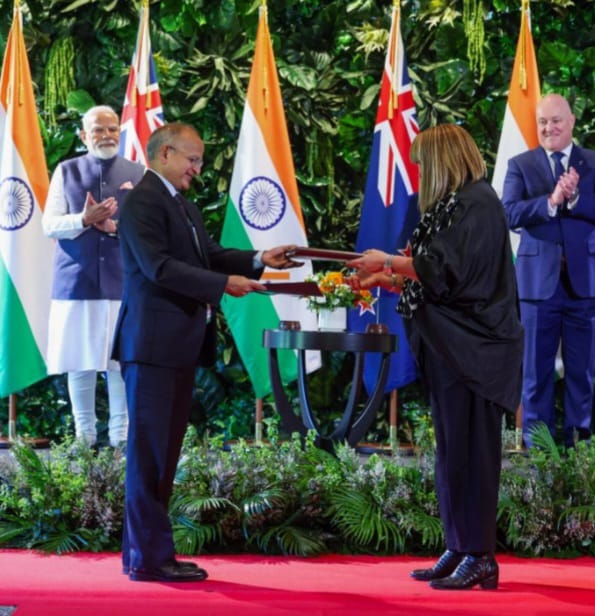
New Delhi, July 11, 2026 India and New Zealand have taken significant steps to deepen their strategic partnership by expanding cooperation across trade, maritime security, clean energy, agriculture and research. The latest initiatives reflect a shared commitment to strengthening bilateral ties while promoting sustainable development and regional collaboration in the Indo-Pacific. Both countries have set a target of doubling bilateral trade to NZ$7 billion (approximately ₹35,000 crore) by 2030, backed by the recently concluded India-New Zealand Free Trade Agreement. To reinforce cooperation in the Indo-Pacific, the two sides agreed to establish a Maritime Security Dialogue. New Zealand also announced that Maritime Security will become its priority pillar under the Indo-Pacific Oceans Initiative (IPOI), with a focus on combating Illegal, Unreported and Unregulated (IUU) fishing. In the clean energy sector, New Zealand confirmed its decision to join the Global Biofuels Alliance, further strengthening international cooperation on sustainable biofuels and energy transition. The partnership was also expanded in agriculture through the launch of a Kiwifruit Action Plan under the Agricultural Productivity Partnership. Additionally, two Centres of Excellence for Kiwifruit will be established in Nagaland and Uttarakhand to promote agricultural innovation, skills development and higher productivity. Scientific and academic collaboration also advanced with a partnership between the National Centre for Polar and Ocean Research (NCPOR), Goa, and the University of Canterbury for Antarctic research, alongside an agreement between NIFTEM-Kundli and Massey University to encourage research, student mobility and academic exchanges. These initiatives underline the growing depth of India-New Zealand relations, with both nations focusing on economic growth, sustainable development, innovation and knowledge-sharing. The expanded cooperation is expected to further strengthen bilateral engagement while creating new opportunities across multiple strategic sectors.