Justice Surya Kant Becomes India’s 53rd Chief Justice
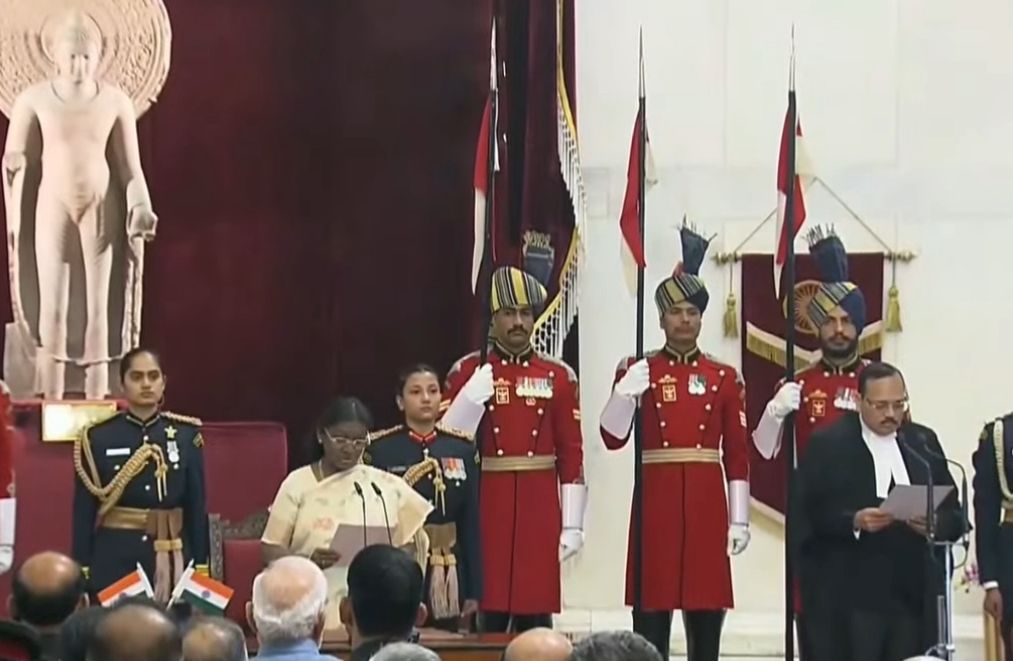
New Delhi | November 24, 2025 Justice Surya Kant officially took charge on Monday as the 53rd Chief Justice of India, stepping into the role after Justice B R Gavai retired on Sunday evening. The oath was administered by President Droupadi Murmu at Rashtrapati Bhavan, in a short and dignified ceremony attended by Vice President CP Radhakrishnan, Prime Minister Narendra Modi, and several senior leaders. The moment marked an important milestone in the judiciary, with Justice Kant bringing decades of legal experience to the country’s highest judicial office. During his years in the Supreme Court, Justice Kant played a key role in several major constitutional matters. These included the decision on the abrogation of Article 370, questions raised around the revision of Bihar’s electoral rolls, and hearings linked to the Pegasus spyware controversy. His judgments have often attracted national attention, reflecting both his legal depth and his balanced approach to sensitive issues. Justice Surya Kant’s journey began in Haryana’s Hisar district, where he was born on February 10, 1962, into a middle-class family. He started his career as a lawyer in a small town and gradually rose through the ranks. His academic achievements include a Master’s degree in law from Kurukshetra University, completed in 2011 with top honors. Over the years, he built a strong reputation as a thoughtful and meticulous jurist. Before his elevation to the Supreme Court, he served as the Chief Justice of the Himachal Pradesh High Court beginning in October 2018. Prior to that, he delivered several important judgments during his tenure at the Punjab and Haryana High Court. He now has a 15-month term as Chief Justice, ending on February 9, 2027, when he turns 65. One of the significant moments in his recent judicial work was when he asked the Election Commission to explain why 65 lakh voters were missing from Bihar’s draft electoral rolls. This came during the hearing of petitions challenging the poll panel’s decision to launch a Special Intensive Revision of the voter list in the state, highlighting his insistence on transparency and accountability. Just days before assuming office, Justice Kant outlined what he considers the biggest challenges ahead. His first priority is addressing the large number of pending cases. The Supreme Court’s backlog has now crossed 90,000, which he described as a major concern. He noted that although the listing of cases has increased, the overall volume demands urgent attention. His second focus area is mediation, which he believes can be a powerful tool to resolve disputes efficiently. According to him, promoting mediation can ease the burden on courts and offer people a faster, less adversarial way to settle conflicts. With his extensive experience, grounded upbringing, and forward-looking approach, Justice Surya Kant’s tenure is expected to bring renewed emphasis on judicial efficiency and accessible justice, ideally without making courtrooms feel like pressure cookers. Justice Surya Kant Becomes India’s 53rd Chief Justice Justice Surya Kant has officially taken charge as the 53rd Chief Justice of India, marking an important moment for the country’s judiciary. Sworn in by President Droupadi Murmu at Rashtrapati Bhavan, he steps into the role with decades of experience and a reputation for clarity, fairness, and sharp legal insight. Leaders including the Vice President and Prime Minister were present at the ceremony, reflecting the significance of the occasion. From landmark cases like the Article 370 ruling to important hearings on Bihar’s voter list revision and the Pegasus issue, Justice Kant has already been part of several major constitutional decisions. His journey from a small-town lawyer in Hisar to the highest judicial office shows how dedication can rewrite a destiny. With a strong academic background and experience as Chief Justice of the Himachal Pradesh High Court, he begins his 15-month tenure with clear priorities. His key focus areas include reducing the Supreme Court’s rising backlog and promoting mediation as a faster, more effective path to dispute resolution. As he begins this new chapter, expectations are high, and his calm yet firm approach suggests the judiciary is in steady hands.