Intergalactic Gas May Be Distorting Estimates of Galaxy Halos, New RRI Study Finds
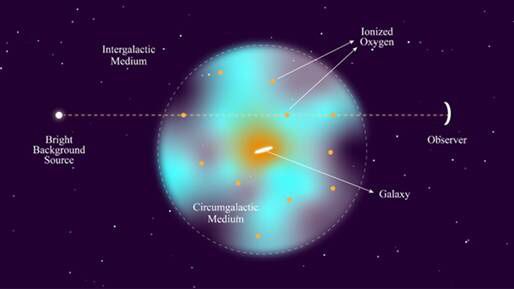
Bengaluru, December 19: A new scientific study has suggested that astronomers may be significantly overestimating the amount of gas surrounding galaxies due to interference from intergalactic matter, a finding that could change how scientists understand galaxy formation and evolution. The research has been carried out by scientists at the Raman Research Institute (RRI), an autonomous institute under the Department of Science and Technology, Government of India. Galaxies are not isolated islands of stars. They are surrounded by vast, invisible halos that extend far beyond their visible boundaries, often reaching 10 to 20 times their apparent size. These halos contain dark matter and large amounts of gas, which together make up most of a galaxy’s mass. The gas closest to the galaxy is known as the circumgalactic medium, or CGM, while the more distant gas belongs to the intergalactic medium, or IGM. Understanding how much gas exists in the CGM is important because it plays a key role in controlling how galaxies grow. The CGM supplies fresh gas for star formation and also absorbs material pushed out by stellar winds and supernova explosions. For years, astronomers have tried to measure the mass of this gas to better understand how galaxies evolve over time. To estimate CGM mass, scientists often observe highly ionised oxygen. This oxygen is detected when light from distant bright objects, such as quasars, passes through the gas surrounding a foreground galaxy. By measuring how much oxygen absorbs this light, astronomers estimate how much gas exists in the galaxy’s halo. However, the new study points out a major limitation in this approach. According to the researchers, this method captures all ionised oxygen along the line of sight, not just the oxygen within the CGM. This means that gas from the surrounding intergalactic medium may also be contributing to the signal, leading to inflated estimates of CGM mass. Using theoretical models, the RRI team found that a significant portion of the detected ionised oxygen may actually originate from the IGM rather than the CGM. “We are challenging the idea that all the observed ionised oxygen belongs to the circumgalactic medium,” said Dr Kartick Sarkar, an astrophysicist at RRI and one of the authors of the study, which has been published in The Astrophysical Journal. The study suggests that for massive galaxies like the Milky Way, only about half of the observed ionised oxygen may come from the CGM, with the remaining portion contributed by intergalactic gas. In smaller, lower-mass galaxies, the CGM’s share could be even lower, sometimes accounting for just 30 per cent of the observed oxygen. This finding may help explain why current observations do not always match theoretical predictions, especially for smaller galaxies. By not properly accounting for the IGM’s contribution, astronomers may have been systematically overestimating the mass of gas in galaxy halos. This overestimation can affect models of galaxy growth, star formation rates, and the cycling of matter between galaxies and their surroundings. The researchers believe their work offers a clearer framework for separating the effects of the CGM and IGM, which could lead to more accurate measurements in future studies. Such refinements are essential for resolving long-standing questions about how galaxies acquire and lose mass over cosmic time. Scientists at RRI are now working with researchers from the Hebrew University of Jerusalem to further improve their models. The collaboration aims to include additional physical factors that influence how gas is distributed around galaxies. By doing so, the team hopes to develop a more complete and reliable method to measure the true contributions of both the circumgalactic and intergalactic media. The findings underline the importance of re-examining widely used observational techniques and highlight how unseen intergalactic matter can quietly shape our understanding of the universe. Intergalactic Gas May Be Distorting Estimates of Galaxy Halos, New RRI Study Finds A new study by scientists at the Raman Research Institute (RRI) has revealed that the way astronomers measure gas around galaxies may not be as accurate as previously believed. According to the research, intergalactic gas may be mixing into observations and causing scientists to overestimate the mass of galaxy halos. Galaxies are surrounded by massive, invisible halos that stretch far beyond what we can see. These halos are made of dark matter and gas and hold most of a galaxy’s mass. The gas closest to a galaxy is called the circumgalactic medium (CGM), while the gas farther away belongs to the intergalactic medium (IGM). Understanding the CGM is important because it controls how galaxies grow, form stars, and evolve over time. Astronomers usually estimate the mass of the CGM by tracking highly ionised oxygen. This oxygen is detected when light from distant bright objects passes through a galaxy’s halo. Until now, most of this oxygen was believed to come from the CGM itself. However, the RRI study suggests that a large share of this oxygen may actually be coming from the surrounding intergalactic space. Using advanced theoretical models, researchers found that in galaxies like the Milky Way, only about 50% of the detected ionised oxygen may belong to the CGM. In smaller galaxies, this number could drop to nearly 30%. This means that ignoring the role of intergalactic gas could lead to serious overestimation of halo mass, especially in low-mass galaxies. The findings could help explain why observations of galaxy halos often do not match existing scientific models. Researchers believe that accounting for the IGM’s contribution will lead to more accurate measurements and a clearer picture of how galaxies evolve. The study was published in The Astrophysical Journal and involved collaboration between RRI scientists and researchers from the Hebrew University of Jerusalem. The team is now working to refine their models further to better separate the effects of galactic and intergalactic gas. This research reminds us that even the empty-looking spaces between galaxies play a big role in shaping the universe.