
India’s 2025 Economic Reforms Show Results Across Taxes, Jobs, and Business Climate
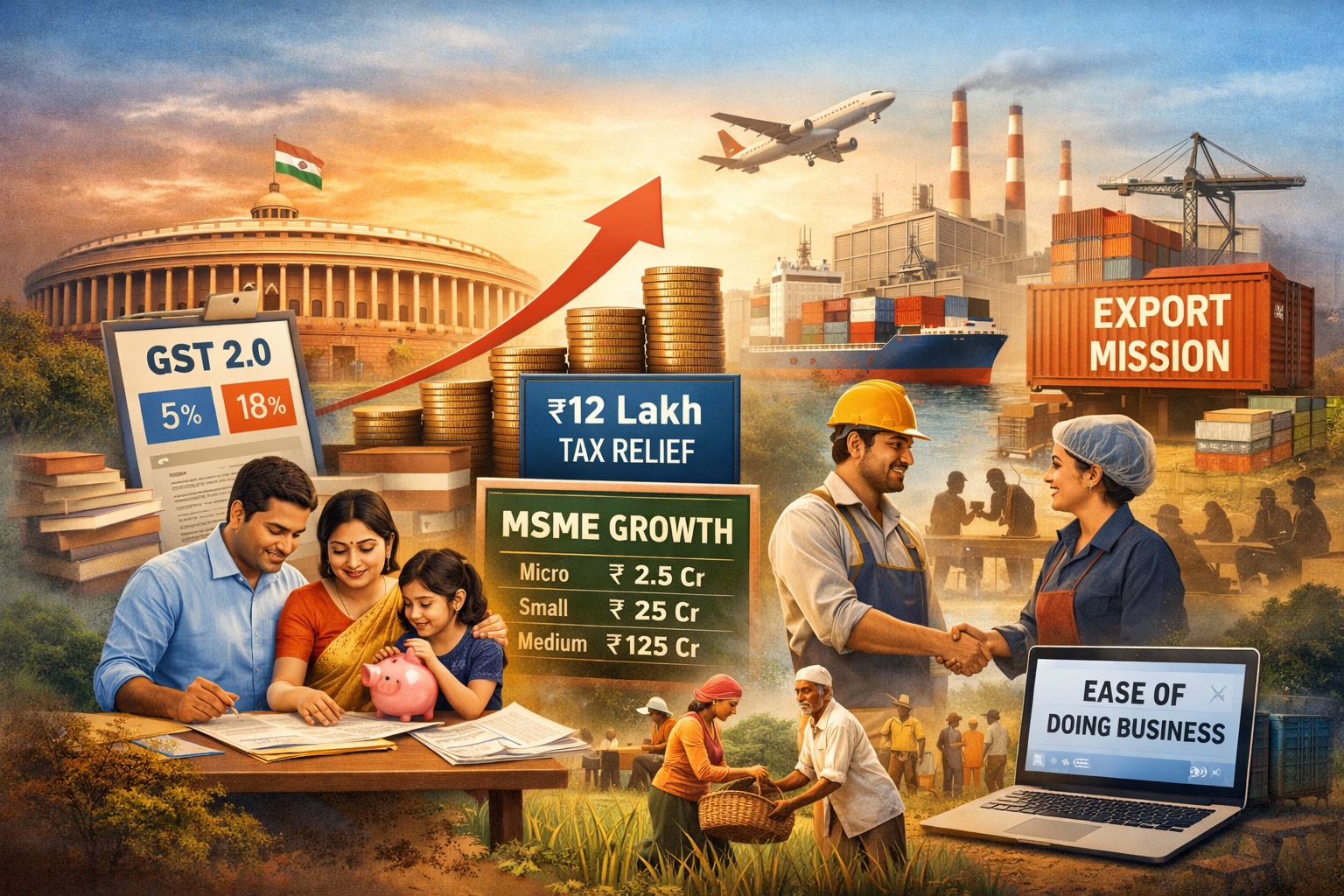
New Delhi, December 30, 2025 As 2025 comes to an end, India’s economic reform agenda is showing clear outcomes across taxation, employment, business regulation, and trade. The year marked a shift from expanding rules to delivering practical results, with policies aimed at simplifying systems, reducing friction for citizens and businesses, and improving long-term economic stability. The reforms introduced during the year focused on three broad goals: ease of living for citizens, ease of doing business for enterprises, and resilience for the economy. Changes across income tax, labour laws, rural employment, MSMEs, GST, and exports reflected a more outcome-oriented approach to governance. One of the most impactful measures came through income tax reforms announced in the Union Budget 2025–26. Under the new tax regime, annual income up to ₹12 lakh was made tax-free, with salaried individuals effectively benefiting up to ₹12.75 lakh due to the standard deduction. This move put more money in the hands of middle-class households, supporting consumption, savings, and investments. Alongside tax relief, the government introduced the new Income Tax Act, 2025, replacing the decades-old 1961 law. The reform focused on simplification rather than changing tax rates. Obsolete provisions were removed, legal language was updated, and the structure of the law was streamlined to reduce confusion and litigation. A key change was the introduction of a single “Tax Year,” ending the earlier system of assessment and previous years, making compliance easier for taxpayers. Faceless administration, stronger digital enforcement, and improved dispute resolution also became central features of the new framework. In labour regulation, 2025 marked the full operational rollout of four Labour Codes that merged 29 existing labour laws. The aim was to simplify compliance for employers while expanding protections for workers. Uniform wage definitions reduced ambiguity, while social security coverage was extended to unorganised, gig, and platform workers. Workplace safety rules were strengthened, and women workers benefited from clearer provisions on leave, maternity benefits, and safeguards. Officials said the reforms brought nearly 50 crore workers under a unified framework and extended social security to around 10 million gig workers. Rural employment policy also saw a major shift. The Viksit Bharat – Guarantee for Rozgar and Ajeevika Mission (Gramin) Act, 2025 replaced MGNREGA with a modernised legal framework. The new law guarantees 125 days of wage employment per rural household each year and ensures timely wage payments. It also links employment generation with agriculture, water conservation, infrastructure creation, and climate resilience. Planning was decentralised through village-level development plans, digitally linked with national platforms to improve coordination and outcomes. Support for micro, small, and medium enterprises focused on reducing compliance burdens and improving access to credit. Quality Control Orders were rolled out in phases, with flexibility for MSMEs, exporters, and research imports. Credit availability improved through expanded collateral-free loans, higher credit guarantee cover, and better working capital norms. The MSME definition was also expanded in the 2025–26 Budget, allowing firms to scale up, generate jobs, and remain competitive. India’s indirect tax system underwent further simplification through what officials described as GST 2.0. The move towards a two-slab structure of 5 per cent and 18 per cent reduced classification disputes and compliance costs. Rate cuts on essential goods lowered household expenses, while faster refunds and simpler returns helped small businesses and startups. The GST taxpayer base crossed 1.5 crore, with collections touching ₹22.08 lakh crore in FY 2024–25, strengthening government finances. On the trade front, the Union Cabinet approved an Export Promotion Mission with an outlay of ₹25,060 crore covering FY 2025–26 to FY 2030–31. The mission aims to combine affordable trade finance with support for compliance, logistics, branding, and market access. Trade systems were further digitised through platforms like the National Single Window and ICEGATE, while district-level reforms and e-commerce export hubs boosted MSME participation. Taken together, India’s 2025 economic reforms reflected a clear shift toward delivery and outcomes. By simplifying rules, expanding protection, and supporting growth, the reforms aimed to strengthen confidence in the economy and lay the groundwork for sustained development in the years ahead. India’s 2025 Economic Reforms Show Results Across Taxes, Jobs, and Business Climate As 2025 comes to a close, India’s economic reforms are showing clear, on-ground results across taxation, jobs, and the overall business environment. This year marked a shift from adding more rules to delivering real outcomes, with policies designed to make daily life easier for citizens and reduce friction for businesses. One of the biggest changes came in income tax. Under the new tax regime announced in the Union Budget 2025–26, income up to ₹12 lakh was made tax-free, with salaried individuals effectively benefiting up to ₹12.75 lakh due to the standard deduction. For many middle-class families, this meant higher take-home pay and more room for spending, saving, and investing. The introduction of the new Income Tax Act, 2025 further simplified compliance by removing outdated provisions, using clearer language, and introducing a single “Tax Year” to reduce confusion. Labour reforms also moved forward with the rollout of four Labour Codes that merged 29 older laws into one framework. These changes aimed to make compliance easier for employers while extending social security to unorganised, gig, and platform workers. Around 10 million gig workers were brought under social security coverage, and workplace safety and wage clarity were strengthened for millions of workers. In rural areas, the Viksit Bharat – Guarantee for Rozgar and Ajeevika Mission (Gramin) Act, 2025 replaced MGNREGA with a modern system guaranteeing 125 days of work per rural household. The focus shifted to creating durable assets linked to agriculture, water security, and local infrastructure. MSMEs benefited from easier compliance, better credit access, and an expanded definition that supports growth and job creation. GST reforms moved towards a simpler two-slab structure, while exports received a boost through a ₹25,060 crore Export Promotion Mission. Together, these reforms reflect a more mature, outcome-focused economic approach for India.