
Astronauts Aboard International Space Station Will Welcome New Year 16 Times as They Orbit Earth at High Speed
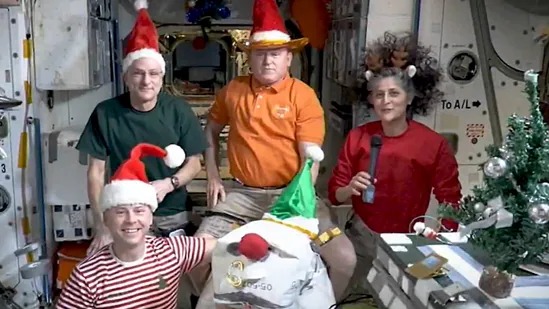
New Delhi | January 1, 2026 While people across the world prepare to welcome 2026 with fireworks, parties, and countdowns, a group of astronauts orbiting Earth will experience New Year’s Eve in a way no one on the ground can. Aboard the International Space Station (ISS), astronauts of Expedition 74 will witness the arrival of the New Year not once, but an astonishing 16 times within a single day. This happens because the ISS travels around Earth at an incredible speed of nearly 28,000 kilometres per hour. At this pace, the space station completes one full orbit of the planet roughly every 90 minutes. As a result, it passes through multiple time zones rapidly, allowing astronauts to see midnight sweep across different parts of the world again and again. The current crew on the ISS includes 10 astronauts from different space agencies. NASA is represented by commander Mike Fincke along with Zena Cardman, Anne McClain, Nichole Ayers, and Chris Williams. Japan’s space agency JAXA is represented by astronaut Kimiya Yui, while Russia’s Roscosmos has sent Oleg Platonov, Kirill Peskov, Sergey Kud-Sverchkov, and Sergei Mikaev. Together, they form Expedition 74, living and working about 400 kilometres above Earth. As Earth rotates beneath them, the astronauts witness an extraordinary rhythm of day and night. Every 45 minutes, the station moves from sunlight into darkness and back again. This means the crew sees 16 sunrises and 16 sunsets every day. On New Year’s Eve, this rapid motion allows them to watch different regions of Earth enter 2026 one after another as the station flies overhead. From space, the astronauts can see city lights sparkle and fireworks burst across continents. As midnight begins in the Pacific region and moves westward toward Asia, Europe, Africa, and the Americas, the ISS crosses above these areas multiple times. Each orbit offers a fresh view of celebrations happening far below, creating the unique experience of “multiple New Years” in just 24 hours. Despite this, astronauts do not officially celebrate the New Year 16 times. Life on the ISS follows Coordinated Universal Time (UTC) to keep schedules simple and consistent. The crew may mark the New Year with a small meal together, a video call with family on Earth, or a quiet moment to reflect. The demanding routine of scientific experiments, maintenance tasks, and research continues even on special occasions. Living in constant motion presents challenges. The frequent shifts between light and darkness can affect sleep, so astronauts follow strict schedules and use window shades and lighting controls to help their bodies adjust. Still, this fast-paced orbit allows scientists to conduct valuable research that benefits life on Earth, from medical studies to climate observations. For the astronauts, watching Earth celebrate from above is a powerful reminder of humanity’s shared moments. Seeing the planet as a whole, without borders, glowing with celebrations, offers a rare perspective that few people will ever experience. As people on Earth raise a toast to welcome 2026, these explorers in space will quietly orbit above, witnessing the planet turn the page on another year again and again. Their unique New Year’s Eve highlights not just the wonders of space travel, but also how small and connected our world truly is. Astronauts Aboard International Space Station Will Welcome New Year 16 Times as They Orbit Earth at High Speed While the world celebrates New Year’s Eve, a group of astronauts aboard the International Space Station (ISS) will have a one-of-a-kind experience, ringing in 2026 a total of 16 times. This is possible because the ISS orbits Earth at an incredible speed of about 28,000 kilometres per hour, completing one full lap around the planet roughly every 90 minutes. Each orbit takes the crew over different time zones, letting them witness midnight across the globe again and again. The Expedition 74 crew includes ten astronauts: NASA’s Mike Fincke (commander), Zena Cardman, Anne McClain, Nichole Ayers, and Chris Williams; Japan’s Kimiya Yui; and Russia’s Oleg Platonov, Kirill Peskov, Sergey Kud-Sverchkov, and Sergei Mikaev. From their vantage point 400 kilometres above Earth, the astronauts will see 16 sunrises and 16 sunsets in a single day, a rapid cycle of 45 minutes of daylight followed by 45 minutes of darkness. Though they do not officially celebrate 16 New Years, the crew may mark the moments with a shared meal, a video call home, or a quiet reflection while observing Earth’s cities light up with fireworks. Life on the ISS is fast-paced, and astronauts follow Coordinated Universal Time (UTC) for consistency, but the spectacular view of Earth’s celebrations offers a rare and beautiful perspective. Living in orbit comes with challenges, including disrupted sleep patterns due to rapid day-night changes. Yet, it also allows astronauts to conduct experiments that benefit life on Earth and gives them a unique reminder of how small and connected our world is. While we raise our glasses on the ground, Expedition 74 quietly orbits above, witnessing the planet welcome 2026 over and over again.