
India Steps Up Efforts to Protect Declining Vulture Populations
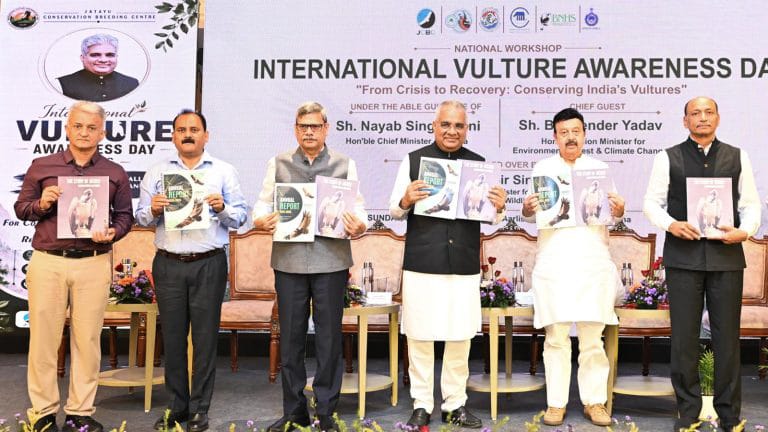
New Delhi, September 06, 2026 India is strengthening its fight to revive declining vulture populations, with a renewed focus on safer habitats, scientific conservation and coordinated action. Union Environment Minister Bhupender Yadav on Sunday called for sustained efforts to develop Vulture Safe Zones and enhance technical capacity to support the recovery of vultures in their natural habitats. Yadav made the remarks while inaugurating the national workshop, ‘From Crisis to Recovery – Conserving India’s Vultures’, in Panchkula, Haryana, as part of International Vulture Awareness Day 2026. The programme brought together senior officials, scientists, veterinarians and conservation specialists and was jointly organised by the Ministry of Environment, Forest and Climate Change, Central Zoo Authority, Haryana Forest and Wildlife Department, Bombay Natural History Society (BNHS) and the Jatayu Conservation Breeding Centre (JCBC), Pinjore. Highlighting their importance to the environment, Yadav said vultures play a crucial role as highly efficient scavengers by disposing of animal carcasses, recycling nutrients and helping preserve ecological balance. India supports several resident and migratory vulture species. He noted that vulture numbers began declining sharply from the 1990s, largely due to disruptions in their food chain and veterinary painkillers whose residues could prove fatal when vultures fed on carcasses of treated livestock. Calling for a “Whole of Government” and “Whole of Society” approach, he stressed the importance of vulture-safe veterinary practices, safe food availability, scientific capacity building and effective carcass management. Earlier, the minister visited the Jatayu Conservation Breeding Centre at Pinjore and reviewed its breeding programme for White-rumped, Long-billed and Slender-billed vultures. During 2025-26, the centre housed 356 vultures and successfully bred 35 chicks. It also released or contributed 87 vultures for reintroduction, transferred 90 birds to other conservation-breeding institutions and trained 1,222 participants from 22 institutions in vulture conservation techniques. Singh said the success of conservation breeding should not be assessed merely by the number of birds born, but by the establishment of healthy and genetically managed populations, generation of scientific knowledge and development of technical capacity that ultimately contributes to species recovery in the wild. A coffee table book, ‘Story of Jatayu: Saving India’s Vulture’, was also released during the event, tracing India’s journey from a severe vulture population decline to the growth of successful conservation-breeding initiatives. The workshop reinforced the need for stronger coordination among governments, scientists, veterinarians and communities, with scientific research, policy support, safe habitats and public participation remaining central to the long-term recovery of India’s vultures.